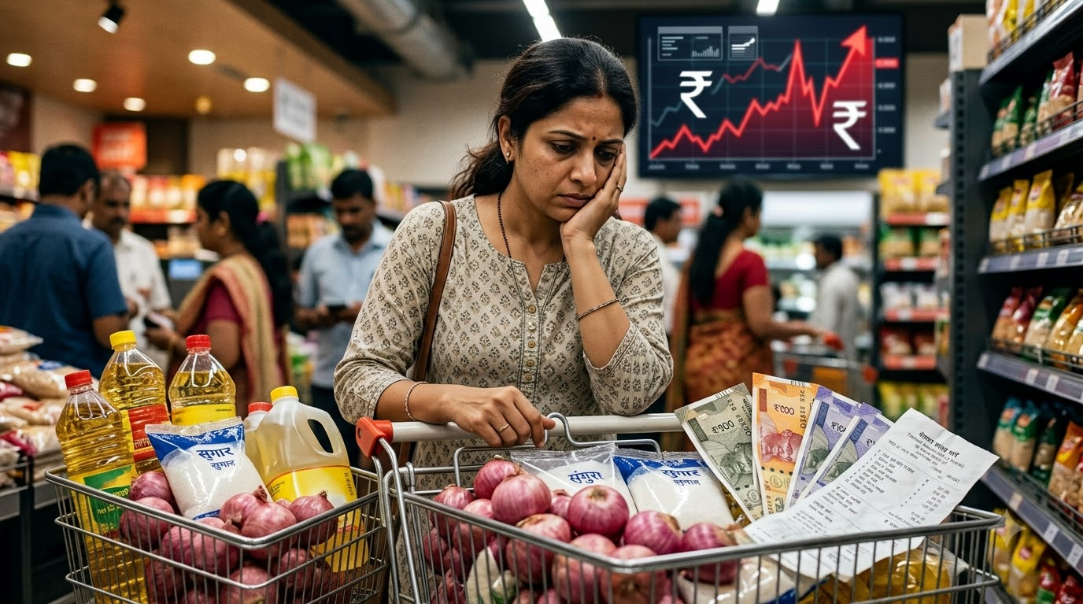

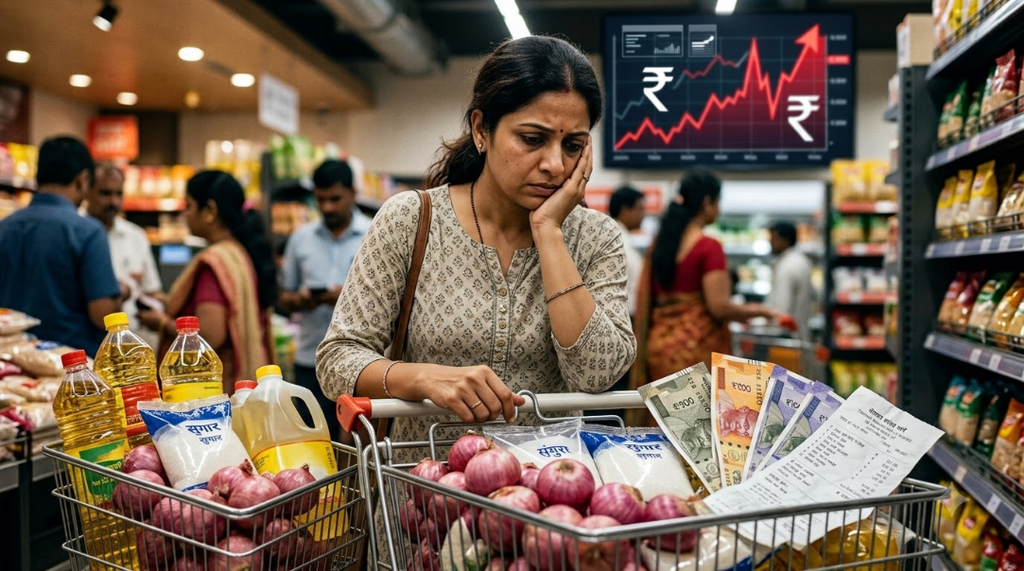
India’s household budgets are facing a fresh test as the prices of some everyday kitchen essentials, particularly sugar and onions, have climbed sharply in recent weeks. Edible oils are also trading at elevated levels, adding to the pressure on consumers.
The timing is important. India is entering a period when demand for sugar traditionally rises because of the festive season. At the same time, official data already showed food inflation accelerating in July.
So, is India heading towards another major inflation wave?
The answer is not necessarily—but the warning signs deserve attention. Retail inflation rose to 4.45% in July 2026, while food inflation increased to 5.52%.
What is Inflation?
Inflation refers to the overall rise in prices of goods and services purchased by households across the country. It is primarily tracked through the Consumer Price Index (CPI). When food, fuel, housing and other everyday costs rise persistently, households need more money to maintain the same standard of living.
What Happened?
The latest government price data shows that several essential commodities have become more expensive.
According to the Department of Consumer Affairs’ Price Monitoring System, the all-India average retail price of sugar reached ₹63.05 per kg on August 24, 2026, compared with ₹51.68 a week earlier and ₹48.73 a month earlier. That represents a sharp short-term increase.
Onions have also moved higher. The average retail price was ₹43.53 per kg on August 24, compared with ₹37.20 a week earlier and ₹35.01 a month earlier. The government data therefore shows a significant increase in onion prices over both one week and one month.
Edible oils remain relatively expensive as well. On August 24, the average retail prices included approximately ₹200.20 per kg for packed mustard oil, ₹207.91 for groundnut oil, ₹191.65 for sunflower oil and ₹165.02 for soya oil.
The price pressure is not limited to one city. The government’s monitoring system collects price information from 555 market centres across India and tracks 22 essential commodities.
Complete Details
Sugar prices are the biggest immediate concern
Sugar has emerged as one of the most closely watched commodities.
Reuters reported on August 24 that Indian sugar prices had risen by more than 40% over two months to a record level. Industry representatives said the rally was being driven partly by speculative buying rather than an actual nationwide shortage.
The government has already responded.
India has allowed duty-free imports of 1 million tonnes of raw sugar to increase domestic availability and cool prices. The measure is allowed until October 31, ahead of the peak festive demand period.
This is significant because India normally maintains a high import duty on sugar. The decision signals that authorities are taking the price movement seriously.
However, the situation is more complicated than simply saying there is a sugar shortage.
Industry estimates cited by Reuters put sugar production for the marketing year ending September 30 at around 27.9 million tonnes, against domestic consumption of roughly 28–28.5 million tonnes. Stocks at the beginning of the next season are also expected to be lower than last year.
Festival demand could therefore keep the market under pressure.
Onion prices are another warning signal
Onions are particularly important for India’s food economy because they are consumed widely across households and the restaurant sector.
Government data shows the average retail onion price rising from ₹35.01 per kg on July 24 to ₹43.53 per kg on August 24—an increase of about 24% in one month.
The government has begun taking measures to prevent onion prices from rising further.
Reports indicate that buffer stocks are being released, while special transportation arrangements—including the Kanda Express initiative—are being used to move onions from producing areas to major cities.
The Centre is also preparing subsidised retail intervention in Delhi-NCR, with onions planned to be sold at ₹35 per kg through government-supported channels.
What about edible oil prices?
Edible oils are a slightly different story.
Unlike onion prices, which can swing sharply because of domestic crop and storage conditions, cooking oil prices are also influenced by international commodity markets, import costs, currency movements and domestic supply.
Government data on August 24 showed mustard oil at around ₹200.20 per kg, groundnut oil at ₹207.91, sunflower oil at ₹191.65 and soya oil at ₹165.02.
Higher cooking oil prices can have a broader effect because they increase food preparation costs for households, restaurants, snack manufacturers and other food businesses.
July inflation already showed pressure
The latest official CPI figures provide important context.
India’s headline retail inflation increased from 4.38% in June to 4.45% in July 2026. More importantly, food inflation rose from 5.32% to 5.52%. Rural food inflation stood at 5.79%, while urban food inflation was 5.05%.
Onion inflation was particularly notable, with the year-on-year rate reaching 22.54% in July, compared with 4.73% in June. Ginger and garlic also recorded significant increases.
This means the current rise in commodity prices is occurring against an already firmer food-inflation backdrop.
Why This Matters
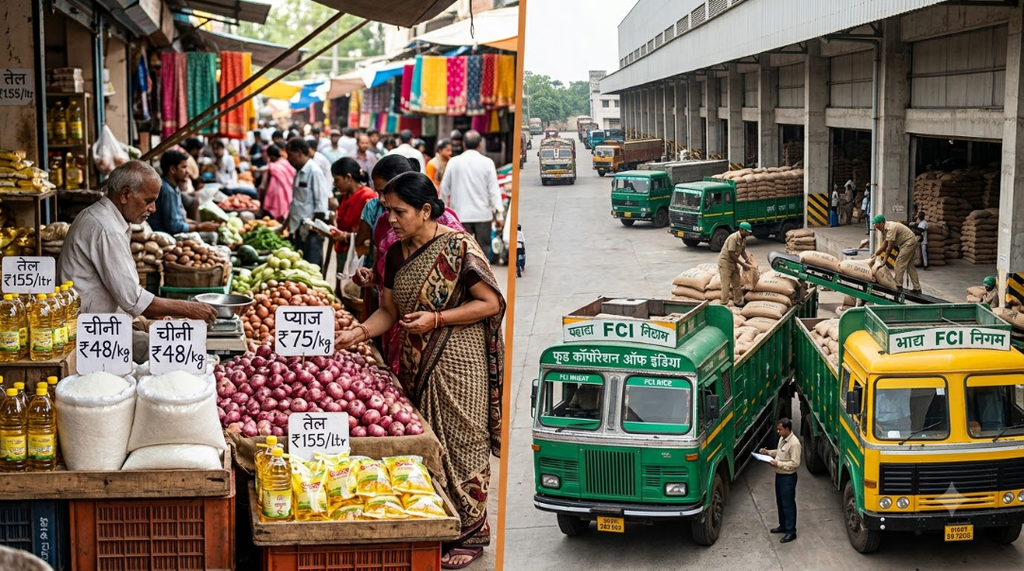
The biggest concern is not that sugar, onions or cooking oil have become expensive individually.
The real concern is whether higher prices spread to a wider range of goods and services.
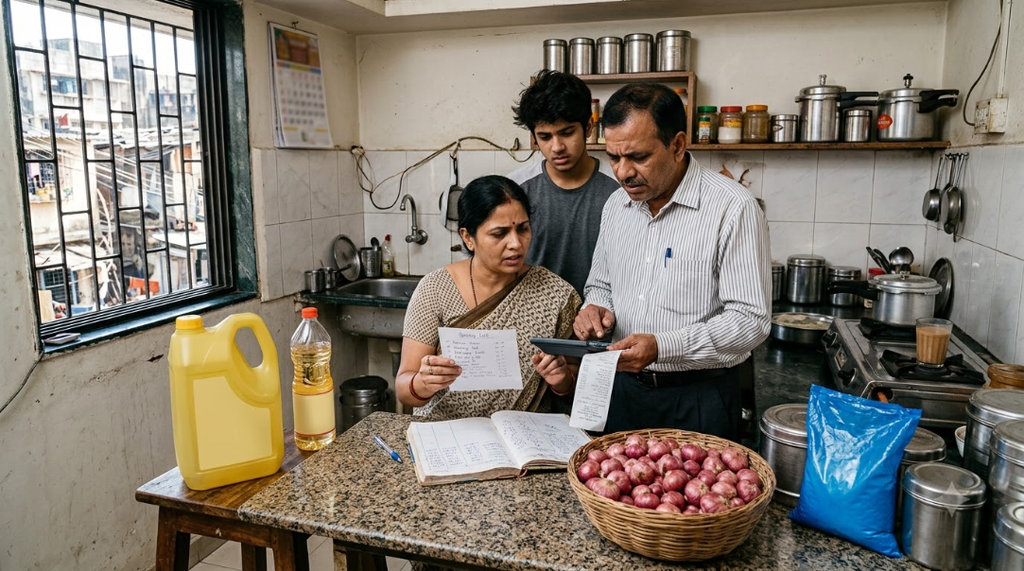
When food costs rise, households have less disposable income for other spending. Businesses may also face higher input costs and eventually pass some of those costs to consumers.
The impact can be seen through:
- Higher monthly grocery bills
- Increased restaurant and food-service costs
- Higher prices for sweets and bakery products
- Pressure on household savings
- Reduced purchasing power
- Greater pressure on food inflation
- Potential changes in interest-rate expectations if inflation remains persistent
A CRISIL report cited by Mint found that the cost of a home-cooked vegetarian thali rose 4% year-on-year in July, while the non-vegetarian thali cost increased 9%. Higher onion, vegetable oil and LPG prices were among the factors contributing to the increase.
That shows how individual commodity increases can eventually affect the cost of an entire meal.
Public/Expert Reaction
Market participants and industry representatives are closely watching the sugar market because the coming festive months could increase demand.
The Indian Sugar & Bio-energy Manufacturers Association has said that the current sugar rally does not necessarily reflect an immediate shortage, with speculation and expectations of tighter availability also influencing prices.
The government’s decision to permit duty-free raw sugar imports indicates that policymakers want to increase supply before the festive demand peak.
On onions, the government’s use of buffer stocks and subsidised retail sales reflects a similar strategy: increase market availability and prevent a temporary supply shock from turning into sustained inflation.
For consumers, however, the immediate question is simpler: how long will grocery prices remain elevated?
That will depend heavily on fresh arrivals, festival demand, weather conditions, international commodity prices and government intervention.
Important Facts
| Commodity | Average retail price on Aug. 24, 2026 | Recent movement |
|---|---|---|
| Sugar | ₹63.05/kg | ₹48.73/kg on July 24 |
| Onion | ₹43.53/kg | ₹35.01/kg on July 24 |
| Mustard Oil | ₹200.20/kg | Elevated |
| Groundnut Oil | ₹207.91/kg | Elevated |
| Sunflower Oil | ₹191.65/kg | Elevated |
| Soya Oil | ₹165.02/kg | Elevated |
Source: Department of Consumer Affairs Price Monitoring System.
Key points consumers should know
- India’s retail inflation was 4.45% in July 2026.
- Food inflation was 5.52%.
- Onion inflation was 22.54% year-on-year in July.
- Sugar prices have risen sharply in recent weeks.
- The government has permitted 1 million tonnes of duty-free raw sugar imports.
- Onion buffer stocks are being used to improve market supply.
- Rising commodity prices do not automatically mean India is entering a prolonged inflation crisis.
- The next few months will be important because of increased festive demand.
The RBI’s inflation framework allows headline CPI inflation to move within a 2%–6% tolerance band, although its target is 4%. July’s 4.45% reading therefore remained inside the tolerance band, even as it moved above the target.
Is India Really Heading Towards Inflation?
India is facing an inflation risk, but it is too early to call the current situation a broad-based inflation crisis.
The distinction matters.
A temporary increase in onion or sugar prices can push food inflation higher without creating persistent inflation across the entire economy.
For a serious inflation problem to develop, price increases would generally need to become broader and more persistent, affecting multiple categories of goods and services.
At present, there are both warning signs and mitigating factors.
Factors that could push inflation higher
- Continued onion price increases.
- Sustained sugar price pressure during the festive season.
- Higher edible oil costs.
- Weather-related supply disruptions.
- Higher international commodity prices.
- Businesses passing higher input costs to consumers.
Factors that could prevent a larger inflation surge
- Government release of onion buffer stocks.
- Subsidised onion sales in selected markets.
- Duty-free sugar imports.
- Fresh crop arrivals.
- Lower prices in some other food categories.
- Continued government monitoring of essential commodities.
The Department of Consumer Affairs says its Price Monitoring Division tracks essential commodity prices daily and can implement market interventions when shortages or excessive price pressure emerge.
FAQs
1. Why are sugar prices rising in India?
Sugar prices have risen sharply amid concerns about tighter availability, increased festive demand and market speculation. The government has responded by allowing 1 million tonnes of duty-free raw sugar imports.
2. Why are onion prices increasing?
Onion prices have increased as market supplies and seasonal availability have tightened. The government is releasing buffer stocks and taking steps to move onions to high-demand markets.
3. Will higher sugar and onion prices increase inflation?
They can contribute to food inflation, especially if the increases persist or spread to other food categories. However, individual commodity price increases do not automatically create a broad inflation crisis.
4. What is India’s latest retail inflation rate?
India’s retail CPI inflation was 4.45% in July 2026, up from 4.38% in June. Food inflation was 5.52%.
5. What can the government do to control food inflation?
The government can release buffer stocks, improve supply chains, adjust import duties, permit imports, monitor hoarding and intervene through subsidised retail sales. Several of these measures are already being used for sugar and onions.
Final Verdict
India is not yet facing a full-blown inflation crisis, but the recent rise in sugar and onion prices is a clear warning sign.
The most important issue is whether these price increases remain concentrated in a few commodities or spread across the wider food basket.
July’s 4.45% retail inflation and 5.52% food inflation show that price pressures have already strengthened. Meanwhile, the sharp movement in sugar and onions means the coming festive months will be closely watched by consumers, businesses and policymakers.
Government intervention could help prevent a temporary supply squeeze from becoming a larger inflation problem. Duty-free sugar imports and onion buffer-stock releases are particularly important steps.
For households, however, the impact is already being felt in the grocery budget.
The key question is no longer simply whether prices are rising—it is whether they stay high for long enough to change India’s broader inflation trajectory.
For More Such Amazing Content Please Visit : https://dailykhabrein.com/


 By
By